

CO-97 Denial Code: Why Bundled Services Get Denied
The CO-97 denial code means the payer treated a billed service as already included in the payment for another service or procedure on the same claim or date. The CO group code makes the bundled amount a provider adjustment, so the patient is not billed for it. This guide explains why services get bundled, how NCCI edits and modifier indicators work, when a modifier is appropriate, how to fix a CO-97, and how much bundling errors can cost.
| Key takeaways CARC 97 means the benefit for the service is included in another service’s payment or allowance.On Medicare claims, most CO-97 denials come from NCCI procedure-to-procedure edits.A modifier can bypass an edit only when the modifier indicator allows it and the record shows a distinct service.When the record does not support a separate service, the bundled amount is normally a contractual write-off. |
What Does the CO-97 Denial Code Mean?
The CO-97 denial code combines group code CO, contractual obligation, with claim adjustment reason code (CARC) 97: the benefit for this service is included in the payment or allowance for another service or procedure. In plain terms, the payer paid one service and considers the other part of it.
Bundling is a coding question first, so CO-97 sits naturally under your medical coding services rather than general A/R follow-up. Noridian’s Medicare guidance on reason code 97 with remark code M80 shows a common pairing: M80 says the service is not covered when billed in the same session or date as a previously processed service. It advises reviewing related items on the same date, then adjusting the balance or appealing with documentation that supports the service.
Why Do Services Get Bundled?
Services get bundled because payers consider some services part of a larger one, and on Medicare claims that logic is written into National Correct Coding Initiative (NCCI) procedure-to-procedure (PTP) edits.
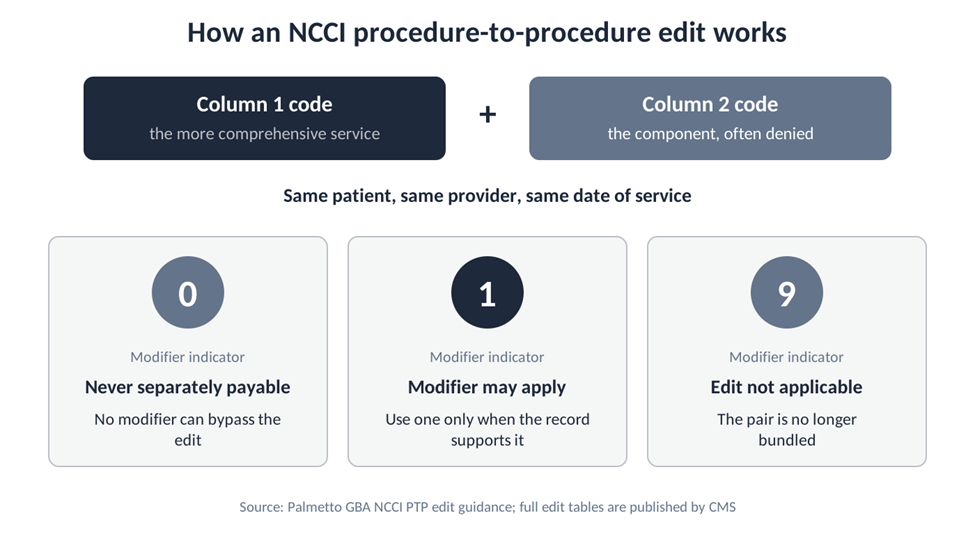
Palmetto GBA’s NCCI PTP edit guidance explains the structure. Each edit pairs a column 1 code, usually the more comprehensive service, with a column 2 code, usually a component. When the same provider bills both for the same patient on the same date, the column 2 code is denied unless an exception applies. Some pairs are mutually exclusive instead and should not be reported together at all.
| Modifier indicator | What it means | What to do |
| 0 | The codes are always bundled | Do not add a modifier; the column 2 code is not separately payable |
| 1 | An exception may apply | Add the right modifier only when the record documents a distinct service |
| 9 | The edit no longer applies | No modifier is needed for the pair |
Bundling also happens outside NCCI. Surgical global packages include routine pre- and post-operative care, and many commercial payers apply NCCI-style edits or their own bundling policies. The edit tables and payer policies change during the year, so check the current version for the date of service.
Which Modifiers Can Unbundle a Service, and When?
A modifier can unbundle a service only when the edit’s modifier indicator is 1 and the medical record shows the service was truly separate, such as a different encounter, site, practitioner or problem. A common example is an evaluation and management (E/M) visit for a separate problem on the same day as a procedure.
| Modifier | Use it when the record shows | Common misuse |
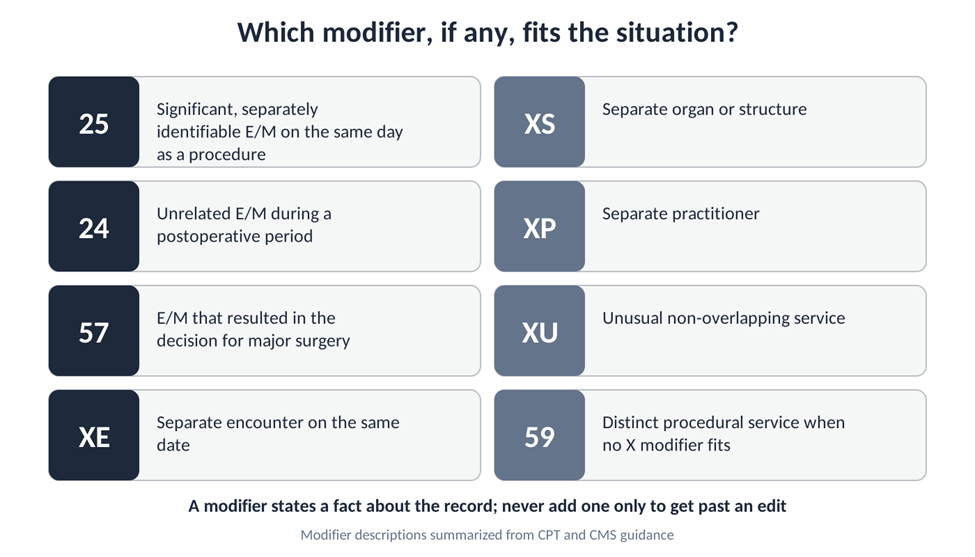
| 25 | A significant, separately identifiable E/M service on the same day as a procedure | Adding it to every E/M billed with a minor procedure |
| 24 | An unrelated E/M service during a postoperative period | Using it for routine follow-up of the surgery |
| 57 | An E/M service that led to the decision for major surgery | Using it for minor procedures |
| XE / XS / XP / XU | A separate encounter, structure, practitioner or unusual non-overlapping service | Picking one without documentation of that fact |
| 59 | A distinct procedural service when a more specific X modifier does not describe it | Using it as a default override |
Modifier descriptions are summarized from CPT and CMS guidance; payers may add their own rules.
In coding audits, a common pattern is modifier 25 applied by default to every visit with a procedure. That habit raises audit risk without fixing the real problem, which is often thin documentation of the separate E/M work. Our CPT coding guide and our AAPC coding guidelines overview cover modifier rules in more depth.
How Do You Fix a CO-97 Denial?
You fix a CO-97 denial by confirming which edit caused it, checking whether the record supports a distinct service, and then correcting, reopening or appealing only when it does.
- Identify the paying code on the same date and confirm which service absorbed the denied one.
- Look up the edit for that code pair and note its modifier indicator for the date of service.
- Read the record for a separate encounter, site, practitioner or problem that justifies the second service.
- If the record supports it, send a corrected claim with the right modifier or use the payer’s reopening or appeal route; on Medicare, Noridian points to a redetermination with supporting documents.
- If it does not, post the bundled amount as a contractual adjustment and fix the charge rule that created it.
Illustrative scenario (not an actual client record)
A family physician removes a skin lesion and, at the same visit, adjusts the patient’s blood pressure medication after a full review. The claim goes out without modifier 25, and the E/M line returns CO-97. The note documents the separate hypertension work, so the coder adds modifier 25 to the E/M and sends a corrected claim. The practice then updates its charge review so same-day E/M lines are checked before release.

How Much Can Bundling Denials Cost a Practice?
Bundling denials cost a practice the full allowed amount of each line that could have been paid separately, and the loss compounds quietly because CO-97 lines often look like normal adjustments.
Formula
- Monthly revenue at risk = number of CO-97 lines that the record could have supported x average allowed amount per line
Walkthrough: if 30 same-day E/M lines a month return CO-97 when the notes actually support modifier 25, and the average allowed amount is $95, the practice leaves 30 x $95 = $2,850 a month on the table. These numbers are illustrative; your allowed amounts depend on your payer contracts and fee schedules.
In A/R reviews, a frequent finding is that CO-97 lines are posted as routine contractual adjustments and never reviewed. A monthly sample of CO-97 lines, checked against the notes, usually shows whether the issue is coding, documentation or genuine bundling. For a wider denial plan, see our guide on how to reduce claim denials and our physician coding guide.
When Should You Get Outside Coding Support?
Outside coding support makes sense when CO-97 keeps returning on the same code pairs. Signals include:
- The same E/M and procedure pair is denied as bundled most months
- Modifier 25 or 59 is added by default rather than by documentation
- CO-97 adjustments are posted without review
- Nobody checks edit updates before they take effect
EON Med Solutions is one example of a partner that handles billing, coding, credentialing, denial management and reporting end to end through a US-based team with transparent reporting. Its denial management service reviews adjustment patterns like CO-97 and routes coding issues back to the source. Results vary by practice, specialty and payer mix.
CO-97 Questions Coders Ask
Can a CO-97 denial be appealed?
Yes, when the record shows a distinct service that the edit allows to be reported. On Medicare, Noridian points to a redetermination with supporting documentation, or a corrected claim when a modifier was simply left off. If the edit’s modifier indicator is 0, no modifier or appeal will make the column 2 code payable.
Can we bill the patient for a CO-97 bundled service?
No. The CO group code means contractual obligation, so the bundled amount is a provider adjustment under the payer agreement. The payer has already paid for the service as part of another one, and billing the patient separately for it would conflict with the contract.
What is the difference between CO-97 and CO-50?
CO-97 says the service was paid as part of another service, so it is a bundling decision. CO-50 says the payer did not consider the service medically necessary at all. CO-97 usually turns on coding and modifiers, while CO-50 turns on coverage criteria and documentation.
Is modifier 59 still valid for Medicare?
Yes. Medicare accepts modifier 59 and the more specific XE, XS, XP and XU modifiers to bypass edits whose modifier indicator allows it. Use the X modifier that describes the situation when one fits, and keep documentation that shows why the service was distinct.
What is a good CO-97 rate?
No payer or industry body publishes a required CO-97 rate. As a practical measure, track CO-97 lines that the record could have supported, not every bundling adjustment, since some bundling is correct. A rising count on the same code pair usually points to a charge-entry or documentation habit to fix.
Expert Opinion
From our billing and RCM work, the CO-97 denial code is often a correct adjustment, and the skill lies in spotting the ones that are not. The firm published standards in this guide are the CARC 97 definition, the NCCI column 1 and column 2 structure, and the meaning of modifier indicators 0, 1 and 9, along with the CPT and CMS modifier definitions.
The $2,850 figure and the lesion scenario are illustrative, and the monthly sample review is a practical habit rather than a payer rule. Commercial payers can apply their own bundling policies, so their manuals decide how CO-97 is handled.
The natural next question is how many of your CO-97 adjustments the record could actually support. If you would like a second look, the EON Med Solutions Billing & RCM Team is glad to review a sample with you; you can contact our team whenever it suits you.
Sources: Palmetto GBA NCCI procedure-to-procedure edit guidance, Noridian Medicare guidance on reason code 97 with remark code M80, and CPT and CMS modifier definitions. This article is general billing information, not legal advice. Results vary by practice, and figures reflect information available at the time of research.


