

What Providers Need to Know About 2027 CPT Codes?
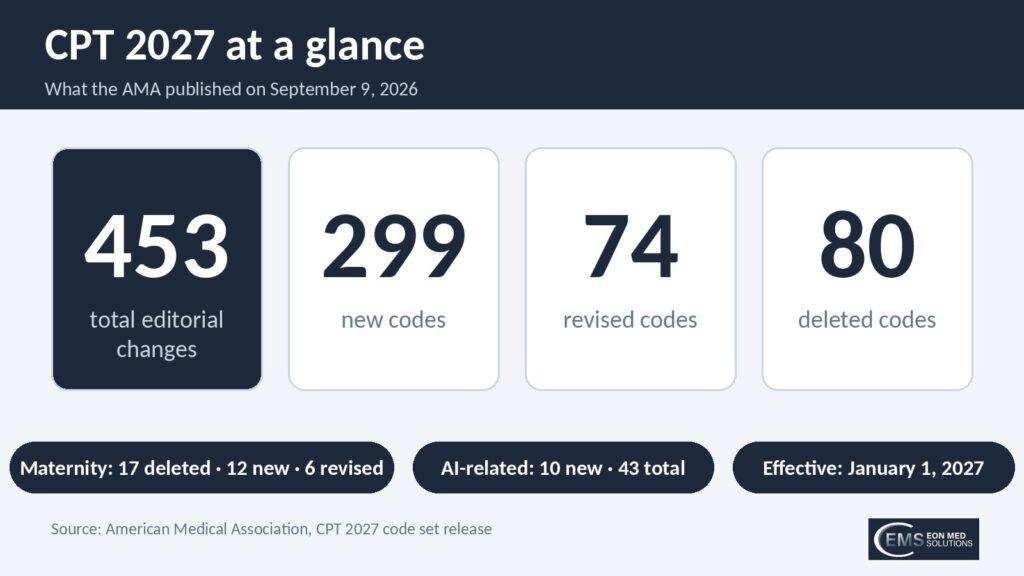
What providers need to know about 2027 CPT codes starts with scale and timing. The AMA’s 2027 CPT code set adds 299 new codes, revises 74, and deletes 80. All changes take effect January 1, 2027, and maternity care sees the largest operational shift.
Code changes rarely announce themselves until claims start bouncing back. This guide covers what providers need to know about 2027 CPT codes before January arrives. You will learn which specialties are affected and what Medicare has proposed for payment. You will also get a realistic readiness plan. Four worked calculations show the financial stakes in plain numbers. A short self-assessment checklist near the end lets you score your own preparation. Every figure carries a source label, so you can tell a published count from a practical planning target. Share it with your billing lead.
Quick-Reference Numbers for CPT 2027
| Metric | Figure or Practical Target | Review Frequency | Primary Source |
| Total editorial changes | 453 | Once, at codebook review | Published (AMA) |
| New / revised / deleted codes | 299 / 74 / 80 | Once, then quarterly | Published (AMA) |
| Effective date | January 1, 2027 | Confirm in December | Published (AMA) |
| Maternity codes | 17 deleted, 12 new, 6 revised | Monthly until Q1 | Published (AMA) |
| AI-related CPT codes | 10 new; 43 total | Quarterly | Published (AMA) |
| New Category III codes | 58, effective January 1 | Quarterly | Reported (AAPC) |
| Proposed Medicare conversion factor | $32.84 non-QP; $33.17 QP | Until November final rule | Published proposal (CMS) |
| Clean claim rate | About 95% or higher | Weekly in Q1 | Common benchmark |
| Chargemaster update complete | Before mid-December | One time | Illustrative target |
Source labels: Published (AMA) is the AMA’s own count. Published proposal (CMS) may change in the final rule. Reported means a named outlet reported it. Common benchmark is a commonly cited industry range, not a body-mandated number. Illustrative target is a planning suggestion.
What the AMA Actually Changed for 2027?
Headline Counts and the January 1 Deadline
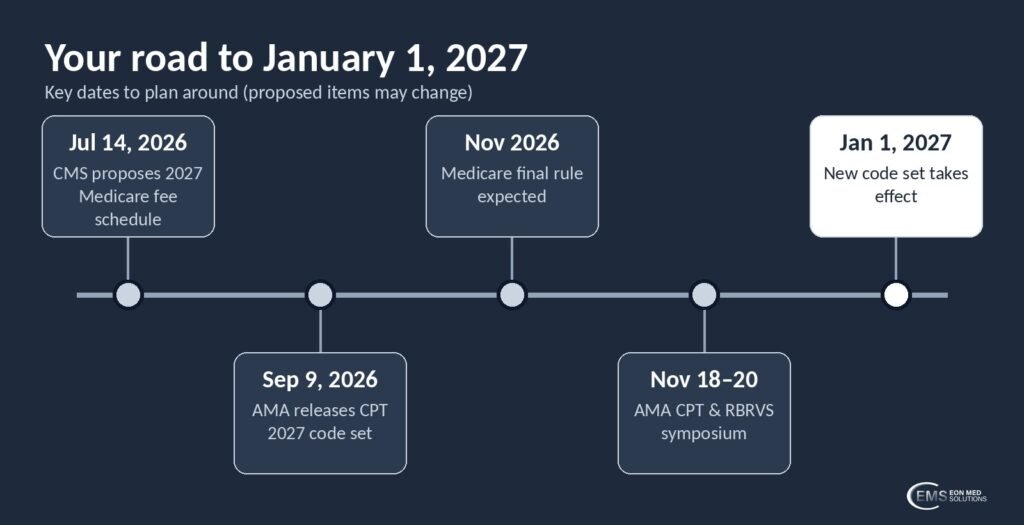
On September 9, 2026, the AMA released the 2027 code set. It lists 453 editorial changes: 299 new codes, 74 revisions, and 80 deletions. Every change takes effect January 1, 2027, per the AMA’s announcement. CPT is the HIPAA standard code set for physician services, so payers expect current codes. Dates of service through December 31, 2026 still use the 2026 set. A deleted code submitted after the switch is likely to cause a rejection or claim denial. Mapping your most-billed codes early is therefore the most valuable first task.
Where the Changes Land?
| Area | What Changed | Look First If You Are | Source |
| Maternity care | Global bundle replaced by phase-based codes | OB/GYN or family practice | AMA |
| Ventricular assist devices | Three new codes | Cardiac surgery | AMA |
| Diaphragmatic hernia repair | Nine new codes | General or thoracic surgery | AMA |
| Prostate biopsy | Updated codes and guidelines | Urology | AMA |
| Biofeedback | New time-based structure | Behavioral health, therapy | AMA |
| Radiology | New and revised codes; head and neck MRA table | Imaging | AMA |
| Sleep medicine | Six new unattended sleep study codes | Sleep, pulmonary | AMA |
| Applied behavior analysis | Six new codes; two Category III codes deleted | ABA providers | Industry-reported |
Maternity Care Moves From One Bundle to Ongoing Billing
For obstetric practices, the restructure is the headline. The AMA is deleting 17 codes, adding 12, and revising six, according to its maternity code page. Industry summaries of the list place the four global package codes (59400, 59510, 59610, 59618) among the deletions. Antepartum and postpartum visits will be reported with evaluation and management (E/M) codes. Labor management and delivery receive their own codes. Instead of one bundled claim after delivery, practices will bill throughout the pregnancy. That raises the stakes for accurate visit leveling and clean documentation.
What Changes in Daily Workflow
- Front desk: create a charge for every prenatal visit, not one global event.
- Providers: document each visit so the chosen E/M level is defensible.
- Billing: track payer-specific transition rules, because payers will not all start alike.
Payment is still unsettled. Medicare has proposed its own valuation for the new codes. The AAPC reports that the debate over relative value units continues. Final values will not be settled until the Medicare final rule, expected in November. Commercial payers and Medicaid will issue separate policies, so do not assume one rule fits everyone. Until then, treat maternity fee schedule updates as provisional. Revisit them once CMS and your largest payers publish final policies, and budget conservatively for the first quarter.
Beyond Maternity: AI, Sleep, and Category III Codes
Several other areas deserve attention. The AMA adds 10 AI-related codes, bringing the total to 43. Six new unattended sleep study codes reflect testing delivered outside traditional sleep centers. Nine new codes cover diaphragmatic hernia repair. Applied behavior analysis gains six codes, according to industry reports that followed the AMA release. Category III codes matter too: the AAPC reported 58 new ones taking effect January 1. These temporary emerging-technology codes mostly track utilization, and payment is often limited. If mapping all of this feels heavy, a dedicated medical coding service can handle the review.
Medicare Pay: What the Proposed 2027 Fee Schedule Shows?
Codes describe services, but payers set the price. CMS released its proposed 2027 Medicare Physician Fee Schedule on July 14, 2026. Its fact sheet lists a $32.84 conversion factor for most clinicians, down 1.68% from $33.40. Qualifying APM participants would see $33.17, down 1.19% from $33.57. The main cause is the expiring one-year 2.5% increase from 2026. These figures are proposals, not final. The final rule is expected in November, so treat any budget built on them as provisional. Our CMS coding guidelines overview explains the wider rules.
Four Worked Calculations
Example 1: Medicare Payment per Service
Formula: Payment = total RVUs × conversion factor
Illustrative example: a service with 3.00 total RVUs pays $100.20 at the current $33.40 factor. At the proposed $32.84 factor, it pays $98.52. That is a $1.68 drop.
Example 2: Annual Medicare Exposure
Formula: Annual change = Medicare allowed amounts × percent change in conversion factor
Illustrative example: $500,000 × 1.68% = $8,400 less per year, before any relative value or practice expense shifts.
Example 3: Cash Held by Code Edits
Formula: Delayed cash = held claims × average allowed amount
Illustrative example: 120 held claims × $85 = $10,200 waiting on corrected codes. Repeated holds are where denial management support often pays off first.
Example 4: Clean Claim Rate
Formula: Clean claim rate = claims accepted on first submission ÷ total claims × 100
Illustrative example: 932 accepted ÷ 1,000 submitted × 100 = 93.2%.
A Practical Readiness Plan Before January 1
Five Steps to Take Now
- Get the official CPT 2027 codebook or data files from the AMA, then review our CPT coding guide.
- Pull your 25 most-billed codes and check each against the deletions and revisions.
- Update the chargemaster and EHR templates, removing deleted codes only for 2027 dates of service.
- Read payer bulletins weekly, since commercial plans and Medicaid publish their own transition rules.
- Train providers on documentation changes, and consider the AMA’s November 18–20 symposium.
Timeframe to Readiness
| Task | Planning Range | Partial Result | Full Result |
| Code mapping review | 1–2 weeks | Top 25 codes checked | All active codes checked |
| Chargemaster and EHR updates | 2–4 weeks | New codes loaded | Deleted codes blocked, tested |
| Staff and provider training | 2–6 weeks | Key staff trained | Documentation audits pass |
| Post-launch monitoring | 60–90 days after Jan 1 | Denial causes found | Clean claim rate stable |
These are general planning ranges, not guarantees. Actual timing varies with practice size and specialty.
Comparing Your Results Fairly After the Switch
Benchmarks only help when you compare like with like. Match your specialty, payer mix, practice size, and reporting period before judging any rate. A January dip is common when new codes roll out. One missed target signals a place to investigate, not a verdict. The 95% clean claim figure is a commonly cited practical target, not a standards-body mandate. Review data by payer, code family, and week. Compare against your own December baseline first, and outside ranges second. For tactics, see our guide to clean claim rate improvement.
How a Blended Average Hides a Problem?
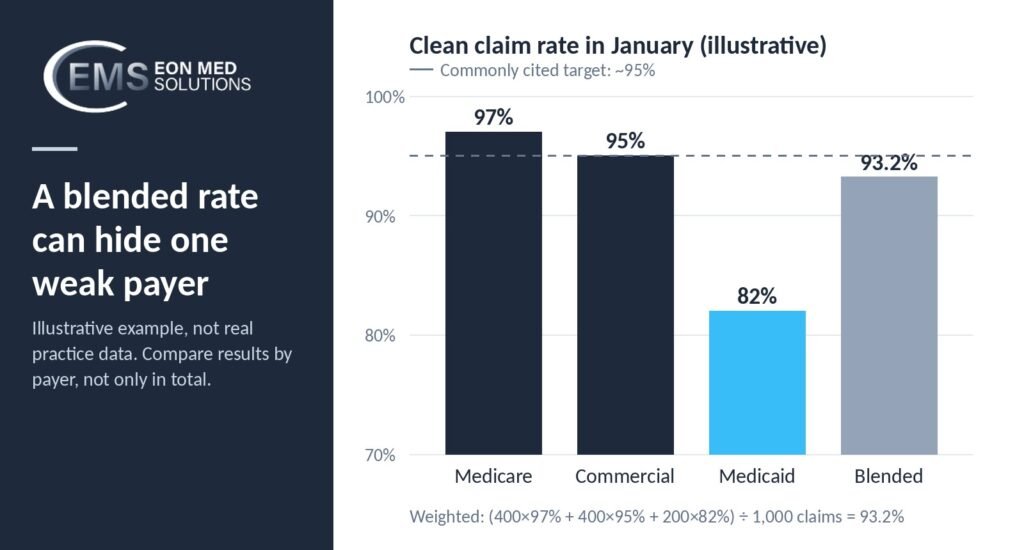
Illustrative scenario (not an actual client record): a practice sends 1,000 claims in January.
| Payer Group | Claims | Clean Claim Rate | Clean Claims |
| Medicare | 400 | 97% | 388 |
| Commercial | 400 | 95% | 380 |
| Medicaid | 200 | 82% | 164 |
| Total (blended) | 1,000 | 93.2% | 932 |
The blended 93.2% looks only slightly below the 95% target, so a busy manager might move on. Yet Medicaid sits 13 points under it. That gap could reflect a payer that has not yet loaded the new codes into its system. It could also point to a template still using a deleted one. Without the payer-level view, the problem stays invisible while denials pile up. These figures are illustrative. Actual rates vary, so verify against your own data source wherever precision matters.
The Short Version: Your 2027 CPT Takeaways
- The AMA published 453 editorial changes, all effective January 1, 2027: 299 new, 74 revised, 80 deleted.
- Maternity care moves from global packages to phase-based reporting, with E/M codes for prenatal and postpartum visits.
- Ten new AI codes and 58 new Category III codes, as reported by the AAPC, expand emerging-technology reporting.
- Proposed Medicare conversion factors are lower, but they are not final until November.
- A clean claim rate near 95% is a commonly cited practical target. Check it by payer.
Is Your Practice Ready? An 8-Question Self-Check
- Do you have the official CPT 2027 codebook or data files? ☐ Yes ☐ No
- Have you checked your fee schedule against the 80 deletions? ☐ Yes ☐ No
- Have you reviewed your 25 most-billed codes for revisions? ☐ Yes ☐ No
- Are your chargemaster and EHR templates updated and tested? ☐ Yes ☐ No
- Have you read your largest payers’ 2027 transition bulletins? ☐ Yes ☐ No
- Have you modeled Medicare payment at the proposed $32.84 factor? ☐ Yes ☐ No
- Do you track clean claim rate by payer, not only in total? ☐ Yes ☐ No
- Will someone review January denials every week? ☐ Yes ☐ No
| Yes Answers | What It Suggests |
| 7–8 | On track. Keep monitoring payer updates through the first quarter. |
| 4–6 | Gaps exist. Close them before mid-December. |
| 0–3 | Urgent. Start with your top codes and payer bulletins this week. |
Expert Opinion
What providers need to know about 2027 CPT codes comes down to early, verified preparation. The clearest signals are the ones you can verify. These include the AMA’s counts of 453 changes, 299 new codes, 74 revisions, and 80 deletions. They also include the January 1 effective date and the maternity restructure: 17 deletions, 12 additions, six revisions. Those are firm, published figures from the AMA itself. Once your team confirms them against the codebook, you can plan the rest with confidence.
Some numbers here are firm and others are practical. The proposed Medicare conversion factors are published but not final. The 95% clean claim rate is a commonly cited industry target, not a standard. The 58 Category III codes come from AAPC reporting. The worked examples, the chargemaster deadline, the timeline ranges, and the payer table are illustrative. Use them to plan, then replace them with your own data. Confirm every detail against the AMA codebook and your payer contracts before acting.
Frequently Asked Questions
What providers need to know about 2027 CPT codes
When do the 2027 CPT codes take effect?
The 2027 CPT code set takes effect January 1, 2027. Claims for dates of service through December 31, 2026 still use the 2026 code set.
How many new CPT codes are there for 2027?
The AMA reports 299 new codes, 74 revisions, and 80 deletions. That totals 453 editorial changes across the code set.
What is a good clean claim rate during a code transition?
A commonly cited practical target is about 95% or higher. Expect a temporary dip in January, and compare rates by payer rather than relying on one blended figure.
What is a good denial rate after new codes launch?
Many industry sources cite a goal below 5%, though reported averages run higher. This is a common benchmark, not a mandated standard, and it varies by specialty.
What is a good deadline for finishing chargemaster updates?
An illustrative planning target is mid-December, which leaves time to test claims. Practices with maternity services may want a few extra weeks.
Are the global maternity codes going away?
Yes. The AMA deletes 17 maternity codes, and industry summaries place the four global package codes among them. Prenatal and postpartum visits move to E/M reporting.
Will the 2027 CPT changes reduce Medicare payment?
CPT codes describe services, while CMS sets Medicare payment. The proposed conversion factor is lower than 2026, mainly because a temporary increase expires.
Does a new AI code guarantee payment?
No. A CPT code allows a service to be reported, but coverage depends on each payer’s policy. Check payer bulletins before billing any new AI-related code.
When Your In-House Approach Hits Its Limits?
Consider outside help if you recognize several of these signals:
- January rejections rise, and no one can name the code causing them.
- Deleted codes still sit in your chargemaster in December.
- Staff spend more time reworking claims than submitting new ones.
- Payer bulletins arrive faster than your team can read them.
- Providers ask about E/M or delivery documentation, and no one owns the answer.
Good outside support should be structured, not vague. Look for certified coders, documented compliance practices, and a named contact who knows your specialty. Ask how code updates reach your chargemaster and how denials get tracked by payer. Ask how often you receive reports. Pricing should be transparent, with no hidden fees. Also confirm how the team handles credentialing, since payer enrollment affects whether new codes get reimbursed. Request sample reports before signing, so you can judge how clearly results are presented.
EON MED SOLUTIONS is one option to weigh against that list. Its US-based team delivers medical billing, coding, credentialing, and revenue cycle management. Reporting is transparent, and there are no hidden fees. The approach links coding review, claim submission, denial management, and compliance support. That way, a code update does not stall in one department. Urgent care, family practice, and multi-specialty groups can review EON’s full service list. Results vary by practice and situation, so start with a conversation about your own codes and payers.
Sources and Method Notes
- Published standards and definitions: AMA CPT 2027 release and AMA maternity page (counts, dates). CMS fact sheet (proposed conversion factors, not final).
- Named benchmarking data providers: none used.
- Practical and illustrative targets: the 95% clean claim rate and sub-5% denial goal are common industry figures. Timeline ranges, the mid-December deadline, and worked examples are illustrative.
- Reported by named outlets: AAPC (58 Category III codes; maternity valuation debate). Industry ABA billing sites (six new ABA codes).
- Survey data: none used.
Actual results vary by practice and situation. Figures reflect information available on September 19, 2026, and the Medicare final rule may change payment details.


