

Average Timeline for Insurance Payer Enrollment
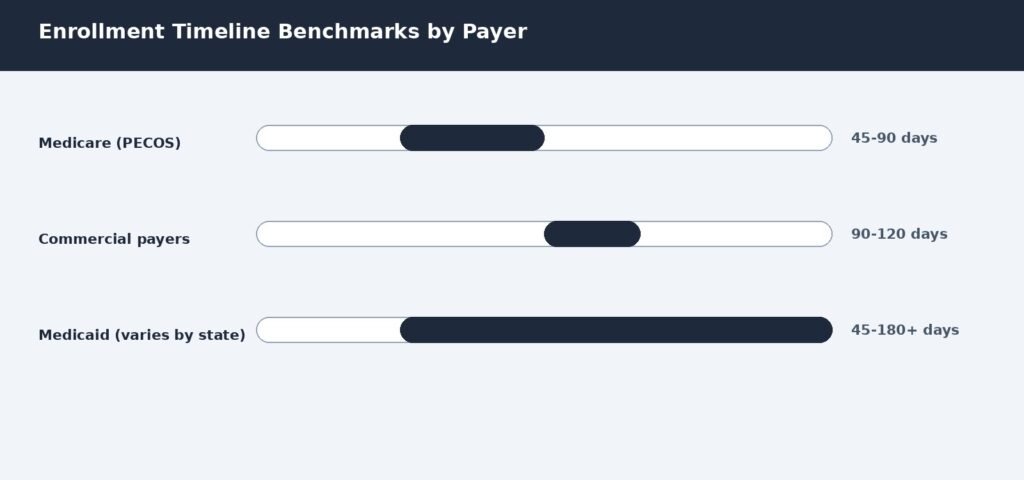
The average timeline for insurance payer enrollment runs roughly 90 to 120 days for commercial payers, 45 to 90 days for Medicare through PECOS, and anywhere from 45 to 180 or more days for Medicaid depending on the state — measured from a complete application to an approved, billable effective date. That range isn’t arbitrary: it reflects primary source verification requirements, payer-specific committee review cycles, and how complete the application was on first submission, which is the single biggest lever a practice actually controls.
Average timeline for insurance payer enrollment-A new provider can be fully hired, credentialed by the hospital, and ready to see patients — and still not generate a dollar of in-network revenue, because payer enrollment hasn’t caught up. That gap is one of the most predictable, and most under-planned-for, sources of lost revenue in a growing practice. This guide covers what actually drives payer enrollment timelines, the standards that shape how payers review applications, and the benchmarks that help set a realistic start date instead of an optimistic one. Near the end, you’ll find a short self-assessment checklist to score your own enrollment process against these numbers.
Key Numbers Cheat Sheet
Each figure below is unpacked further in this guide — bookmark this table as a quick reference rather than trying to absorb it all now.
| Metric | Practical Target/Range | Review Frequency | Primary Source |
| Commercial payer enrollment timeline | 90–120 days | Per application | Commonly reported industry range¹ |
| Medicare enrollment via PECOS | 45–90 days | Per application | Commonly reported industry range¹ |
| Medicaid enrollment | 45–180+ days, varies by state | Per application, per state | Commonly reported industry range¹ |
| NCQA primary source verification window | 120 days (Accreditation) / 90 days (Certification) | Per credentialing file | Published accreditation standard² |
| CAQH profile attestation cycle | Every 120 days | Ongoing | Published platform requirement² |
| NCQA recredentialing cycle | Every 36 months | Per provider | Published accreditation standard² |
¹ Commonly reported industry range = a figure cited consistently across multiple industry sources rather than one controlled study. ² Published accreditation/platform standard = a documented rule from NCQA (a private, voluntary accreditation body) or CAQH (the credentialing data platform), not a government mandate and not a guarantee for any individual application.
Credentialing, Enrollment, and Recredentialing Aren’t the Same Thing
These three terms get used interchangeably, but they’re distinct steps with different owners and different clocks. Credentialing is the verification process confirming a provider’s qualifications — license, education, board certification, work history. Enrollment is officially registering that verified provider with a specific insurance network so claims can actually be billed and paid. Recredentialing is the periodic re-verification, typically every 36 months, that keeps a provider active in a network after initial approval.
A provider can be fully credentialed by a hospital’s medical staff office and still be unenrolled with a specific payer — which is why “credentialing is done” and “we can bill this payer” are two different milestones, not one, and treating them as the same thing is a common source of a practice assuming revenue is further along than it actually is.
Why the Timeline Varies So Much by Payer Type?
The spread between a 45-day Medicare approval and a 180-day Medicaid approval isn’t random — it reflects real differences in how each payer type verifies information and who’s actually doing the reviewing. Medicare’s PECOS system is largely standardized and electronic, with most delay coming from incomplete applications rather than the review itself. Commercial payers each run their own credentialing committee on their own schedule, meeting monthly or less often, which creates a hard floor on speed regardless of how clean the application is. Medicaid runs through individual state programs with wildly different levels of automation, which is why its range is the widest of the three.
The Building Blocks: CAQH, Primary Source Verification, and Committee Review
Most commercial credentialing starts with the same foundation: a completed CAQH provider profile, since most commercial payers and many Medicaid managed care plans pull provider data from it rather than collecting it independently. CAQH requires providers to attest to the accuracy of their profile every 120 days — an expired attestation is one of the most common, and most avoidable, causes of a stalled application that has nothing to do with the payer at all.
From there, the payer conducts primary source verification — confirming license, education, and board certification directly with the issuing institution rather than accepting the provider’s word for it — before a credentialing committee formally reviews and approves the file.
Average timeline for insurance payer enrollment-As of July 2025, NCQA’s updated credentialing standards shortened the maximum primary source verification window from 180 days to 120 days for accredited health plans, and to 90 days for certified credentialing organizations. That’s a meaningfully faster standard than many practices are still planning around, since a lot of published guidance online still reflects the older 180-day figure.
Medicare Enrollment Through PECOS: What’s Fixed vs. Variable
Medicare enrollment runs through the Provider Enrollment, Chain and Ownership System (PECOS), and it’s the most standardized of the three payer categories — but “standardized” doesn’t mean “fast” if the application isn’t complete.
Per CMS’s own guidance on Medicare provider enrollment, a Medicare Administrative Contractor (MAC) that needs additional information gives the applicant 30 calendar days to respond — and each round of missing information effectively restarts a portion of the processing clock. An accurate, complete web-based PECOS submission commonly moves faster than a paper one, which is one of the more reliable levers available for shortening this specific timeline.
Worked Example: Stacking the Enrollment Timeline
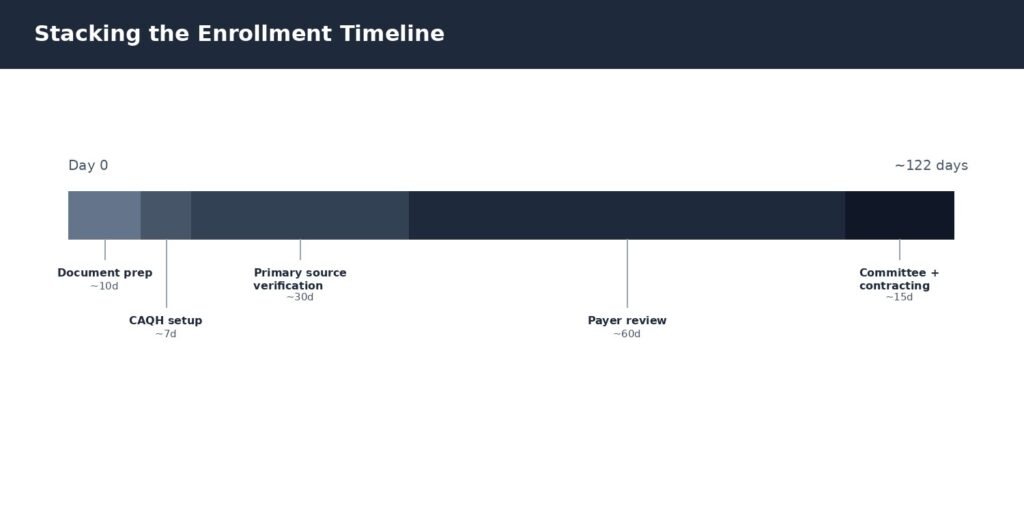
Formula: Total Estimated Timeline = Document Prep + CAQH Setup + Primary Source Verification + Payer Review + Committee/Contracting (stages can overlap somewhat, but payer review typically can’t start until verification is complete). Example: 10 days document prep, 7 days CAQH setup, 30 days primary source verification, 60 days payer review, and 15 days committee and contracting sum to roughly 122 days — near the upper end of the commonly reported commercial range, and a useful reminder that the stages rarely compress as much as an optimistic timeline assumes.
Medicaid: The Widest Variance in the System
Medicaid enrollment is really up to 50 separate state programs, each with its own application, its own verification process, and its own backlog, which is why its range spans from roughly 45 days in more automated states to well over 180 days in states still relying on largely manual review.
A practice enrolling providers across multiple states needs a state-by-state view of Medicaid timelines, not a single national assumption — the same provider profile can clear one state’s Medicaid program in under two months and sit in another state’s queue for six.
Measuring the Cost of Enrollment Delay
The two calculations below turn an abstract delay into a concrete planning number. Both use figures a practice would already have available.
Worked Example: Revenue Impact of Enrollment Delay
Formula: Estimated Delayed Revenue = Average Daily Billable Revenue per Provider × Enrollment Delay Days. Example: a provider expected to generate roughly $2,500 per day in billed charges sits unenrolled with their top-volume payer for 30 days beyond the planned start date, representing $75,000 in revenue that’s delayed — not necessarily lost, since some payers allow retroactive billing, but unavailable until enrollment clears and, for payers without retroactive billing, potentially gone entirely.
Worked Example: Recommended Application Lead Time
Formula: Target Submission Date = Planned Start Date − (Longest Relevant Payer Timeline + Buffer). Example: a practice bringing on a new provider with a planned start date of June 1, billing mostly commercial payers with a 120-day upper-range timeline, plus a 2-week buffer for corrections, should submit applications no later than roughly January 18 — about 4.5 months before the provider’s first patient day, not the 60 days many practices budget for.
Why an Average Timeline Can Hide a Real Problem?
A practice-wide “average enrollment time” can look reasonable while one specific payer is quietly the bottleneck for every new provider. The table below is a hypothetical construct built to illustrate that methodology point — not figures pulled from any study or client record.
Illustrative Enrollment Timeline by Payer (Hypothetical Example)
| Payer | Hypothetical Timeline | Note |
| Medicare (PECOS) | ~55 days | Standardized, mostly electronic |
| Major commercial payer A | ~85 days | Monthly committee cycle |
| Major commercial payer B | ~95 days | Generally efficient |
| Smaller regional/Medicaid MCO | ~165 days | Manual review, limited automation |
| Blended practice average | ~100 days | Masks the regional payer’s real impact |
Illustrative scenario (not an actual client record): a practice tracks a blended average enrollment time of roughly 100 days and assumes its process is reasonably on pace. A payer-level breakdown shows one smaller regional Medicaid MCO consistently running closer to 165 days — nearly double the average — because that payer relies on manual review with limited automation. The specific figures above are constructed to demonstrate this point, not sourced data. Actual figures vary by practice, state, and payer mix; verify against your own enrollment tracking log.
How to Use These Numbers Correctly?
A benchmark here is only useful compared like-for-like. A practice enrolling mostly with Medicare and a couple of large, efficient commercial payers will naturally show a faster blended timeline than one enrolling heavily with state Medicaid programs, and comparing the two directly produces a misleading conclusion. Match payer mix and state before drawing conclusions from a single average.
One slow application is a signal to investigate, not a verdict on the whole process. Check whether the delay traces back to an incomplete submission, an expired CAQH attestation, or a genuinely slow payer before assuming the entire enrollment workflow needs to change.
Timeframe to Improvement
These figures move around in practice — payer mix, the state you’re enrolling in, and how standardized your internal enrollment process already is all shift the real timeline.
| Change Made | What It Takes | Timeframe | Key Constraint |
| Keep CAQH profile current with 120-day attestations | Calendar reminder + designated owner | Immediate once established | Requires consistent follow-through, not a one-time fix |
| Submit fully complete applications on first pass | Document checklist per payer type | 1–2 weeks to build the checklist | Requires knowing each payer’s specific requirements |
| Prioritize top-volume payers first, not alphabetically | Revenue analysis by payer, then sequencing | 1 week to plan | Requires accurate current payer-mix data |
| Start enrollment 120–150 days before provider start date | Process/calendar change, earlier hiring-to-enrollment handoff | 1 cycle to establish as routine | Requires HR and credentialing teams to coordinate earlier |
Quick Summary
- Plan for 90–120 days with commercial payers, 45–90 with Medicare, and 45–180+ with Medicaid depending on the state.
- Credentialing, enrollment, and recredentialing are three distinct milestones — hospital credentialing doesn’t mean payer enrollment is complete.
- NCQA’s July 2025 standards shortened primary source verification to 120 days (accreditation) or 90 days (certification) — much guidance online is still outdated.
- Keep CAQH attestations current every 120 days — an expired attestation is one of the most common, most avoidable causes of a stalled application.
- Start enrollment 120–150 days before a provider’s planned start date, not 60 — the payer review stage rarely compresses as much as hoped.
- Check enrollment timelines by payer, not just the blended average — one slow payer can hide inside an otherwise reasonable number.
Self-Assessment Checklist
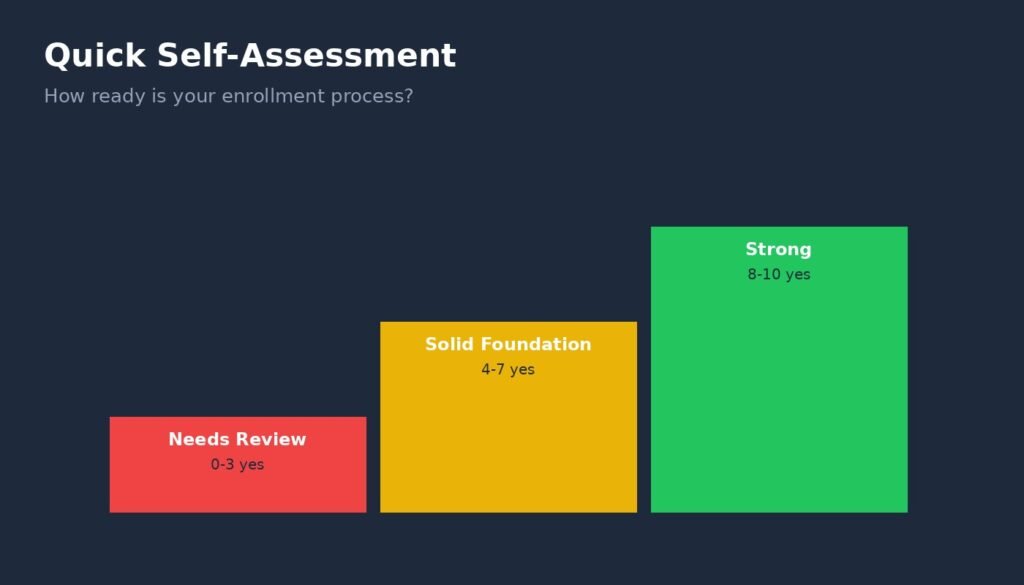
Answer yes or no to each question, then use the scoring guide below.
- Do you know your average enrollment timeline broken out by payer, not just a blended figure?
- Can you name your slowest payer for enrollment and roughly why?
- Do you start payer enrollment at least 120 days before a provider’s planned start date?
- Are CAQH attestations tracked and renewed on a 120-day cycle, not left to expire?
- Do you have a documented, payer-specific checklist to avoid incomplete first submissions?
- Do you prioritize enrollment by payer volume/revenue impact, not just alphabetically?
- Do you track Medicaid enrollment by state rather than assuming one national timeline?
- Is there a designated owner for enrollment tracking, not something everyone assumes someone else is handling?
- Do you know whether your top payers allow retroactive billing if enrollment is delayed?
- Do you review enrollment delays after the fact to see whether the cause was avoidable?
Scoring guide:
- A score of 8–10 means your enrollment process is well-managed — stay on top of the numbers and you’ll hold that position.
- A score of 4–7 signals a decent process with specific weak points — the items you answered “no” to are usually where the delays start.
- A score of 0–3 suggests enrollment isn’t yet a structured process at your practice, and that’s worth fixing before it costs more revenue delay.
Expert Opinion
Here’s where the math usually goes wrong: a practice budgets 60 days for enrollment because that fit the hiring timeline, not because any payer actually works on that schedule. The provider starts seeing patients on day one, claims pile up unbilled, and the real timeline only surfaces once the revenue gap has already opened. Enrollment isn’t a deadline you can negotiate — it behaves more like a fixed constraint, governed by committee schedules and verification requirements outside the practice’s control.
That distinction carries through to sourcing: NCQA’s verification windows and CAQH’s attestation cycle are documented, published standards, whereas payer-type timelines and delay-cost figures are pulled from commonly reported industry ranges rather than a single controlled study. None of it guarantees an outcome for any specific application — payer mix, state, and how complete the application is all move the real number.
This connects to the rest of the revenue cycle in an obvious but often overlooked way: every article in this series about faster claims, cleaner submissions, and tighter A/R follow-up assumes a provider is actually enrolled and billable in the first place. Enrollment isn’t a one-time onboarding task sitting outside the revenue cycle — it’s the very first stage of it, and a slow one there delays everything downstream by definition.
— EON Med Solutions RCM Team
Frequently Asked Questions
What is the average timeline for insurance payer enrollment?
Commonly reported ranges are 90 to 120 days for commercial payers, 45 to 90 days for Medicare through PECOS, and 45 to 180 or more days for Medicaid depending on the state, measured from a complete application to an approved, billable effective date.
What’s the difference between credentialing and payer enrollment?
Credentialing verifies a provider’s qualifications — license, education, board certification. Enrollment is the separate step of officially registering that verified provider with a specific insurance network so claims can be billed and paid under that plan.
What is a good CAQH attestation cadence?
CAQH requires providers to attest to their profile’s accuracy every 120 days. Letting that attestation lapse is one of the most common, avoidable causes of a stalled enrollment application that has nothing to do with the payer itself.
How long does Medicare enrollment take through PECOS?
Commonly reported timelines run 45 to 90 days, with accurate, complete web-based submissions generally moving faster than paper ones. Missing information can add significant delay, since the Medicare Administrative Contractor gives the applicant 30 days to respond to any request for more information.
Did NCQA’s credentialing standards change recently?
Yes. Effective July 1, 2025, NCQA shortened the maximum primary source verification window from 180 days to 120 days for accredited health plans and to 90 days for certified credentialing organizations — a meaningfully faster standard than a lot of still-circulating guidance reflects.
How far in advance should payer enrollment start?
A commonly recommended lead time is 120 to 150 days before a provider’s planned start date, accounting for the upper end of commercial payer timelines plus a buffer for corrections — considerably longer than the 60 days many practices budget for.
Why does Medicaid enrollment vary so much?
Medicaid isn’t one national system — each state runs its own program with its own application, verification process, and level of automation, which produces a much wider timeline range than Medicare’s more standardized PECOS system.
Can a practice bill for services provided before enrollment is complete?
It depends entirely on the specific payer’s retroactive billing policy. Some payers allow billing back to a provider’s application or hire date once enrollment clears; others do not, which makes confirming this policy in advance an important part of planning for a new provider.
When to Consider Professional Support?
Better internal tracking and earlier lead times can only close so much of the gap. A handful of signals usually mean the underlying process needs outside help: new providers regularly starting before enrollment clears, CAQH attestations that lapse without anyone noticing, one or two payers consistently the slowest for every provider, or enrollment tracked informally rather than through a documented, owned process.
When those signals show up together, it usually means enrollment has been treated as a one-time onboarding task rather than an ongoing operational discipline — which is exactly when it starts costing real revenue as a practice grows or adds providers. At that point, practices generally look for support that treats enrollment as connected to the rest of the revenue cycle, tracked with the same discipline as claims and A/R, not handled ad hoc by whoever has time. That’s the structure worth looking for, whichever vendor or in-house process change ends up filling the gap.
It’s an approach EON Med Solutions builds around directly: payer enrollment tracking sits inside the same connected revenue cycle process as claims submission and A/R follow-up, so a new provider’s billing readiness is tracked with the same visibility as an aging claim. Every plan includes a dedicated RCM manager, and there are no long-term contracts — you can evaluate the fit without committing years upfront. Results vary by practice, payer mix, and state, so the useful next step is comparing your own numbers against the benchmarks above, not taking anyone’s word for it.
If your self-assessment score above flagged more than one gap, reach out to EON Med Solutions for a walkthrough of your current enrollment tracking and payer mix — the goal is a clear, specific list of where a faster, more predictable timeline is realistic for your practice, not a generic pitch.
Sources & Methodology
- Published accreditation standard: NCQA’s Credentialing Accreditation and Certification programs, including the July 2025 shortened primary source verification windows (NCQA.org).
- Published federal guidance: CMS’s Medicare provider enrollment process through PECOS, including the 30-day response window for information requests (CMS.gov).
- Published platform requirement: CAQH’s 120-day provider profile attestation cycle (CAQH.org).
- Commonly reported industry ranges: enrollment timelines by payer type (Medicare, commercial, Medicaid) and revenue impact of delay, compiled from multiple industry sources rather than one named study.
- Illustrative targets: the payer-level enrollment timeline table, explicitly labeled as a hypothetical planning example rather than sourced data.
Actual results vary by practice, payer mix, state, and application completeness. Figures in this article reflect information available at the time of research and should be verified against your own enrollment tracking and each payer’s current published guidance where precision matters.
Reference: NCQA — Credentialing Accreditation & Certification Programs.
Ref: CMS — Medicare Provider Enrollment (PECOS) Resources.
Reference: CAQH — Provider Data Portal.+
Related Reading on EON Med Solutions
Revenue Cycle Management services — how enrollment fits into the broader revenue cycle.
A/R Management — tracking outstanding claims once a provider is enrolled and billing.
Medical Billing KPIs to Track for Practices — a deeper look at the benchmarks referenced above.
Denial Management — what happens when a payer-specific submission issue turns into a denial.


