

Best Practices for Posting Insurance Payments Accurately
Posting insurance payments accurately means matching each payer remittance — ERA or paper EOB — to the correct claim and service line, applying the right contractual adjustment, and flagging any underpayment or denial before the balance moves any further through the revenue cycle. Best practice is to post within 24 to 48 hours of receiving the remittance, reconcile the posted total against the actual bank deposit the same day, and route anything that doesn’t match a payer’s contracted rate to a human for review rather than letting it post automatically.
Best practices for posting insurance payments accurately-Payment posting looks like the easy part of billing — the money already arrived, someone just has to type it in. That assumption is exactly why so many practices carry inflated A/R, silent underpayments, and patient statements built on numbers that later have to be corrected. This guide covers the workflow, the documents involved, and the benchmarks that separate a posting process you can trust from one that’s quietly costing revenue. Near the end, you’ll find a short self-assessment checklist to score your own process against these numbers.
Key Numbers Cheat Sheet
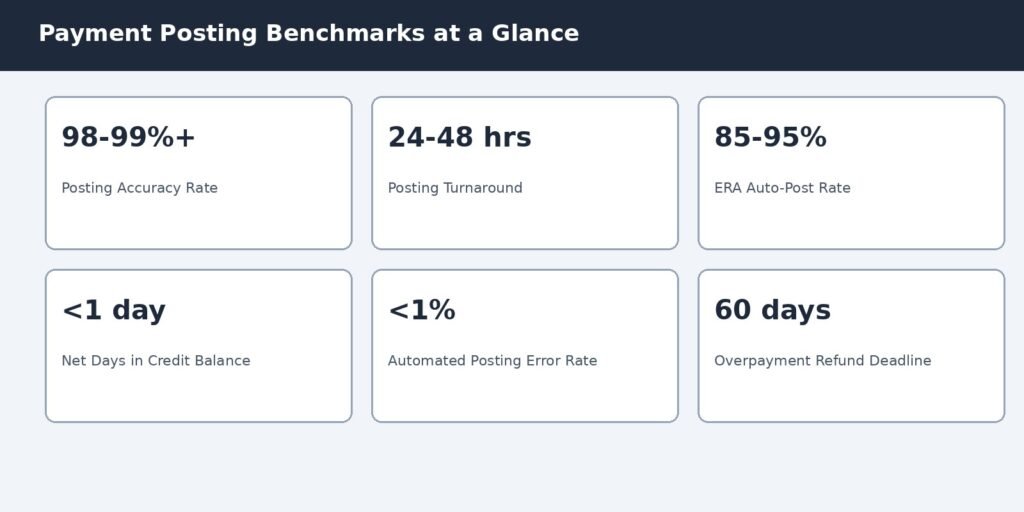
Each figure below is unpacked with a worked example later in this guide — bookmark this table as a quick reference rather than trying to absorb it all now.
| Metric | Practical Target/Range | Review Frequency | Primary Source |
| Posting accuracy rate | 98–99%+ audited postings without correction | Monthly (sample audit) | Commonly reported industry range¹ |
| Posting turnaround time | Within 24–48 hours of ERA/EOB receipt | Daily | Commonly reported industry practice |
| ERA auto-post rate | 85–95% of remits posted without manual touch | Monthly | Commonly reported industry range¹ |
| Net days in credit balance | Under 1 day of net revenue | Monthly | Practitioner-cited benchmark (HFMA)² |
| Manual vs. automated error rate | Manual ~3–5%; automated <1% | Quarterly | Commonly reported industry range¹ |
| Overpayment refund deadline | 60 days after identification | Per occurrence | Published federal standard (42 CFR 401.305)³ |
¹ Commonly reported industry range = a figure cited consistently across multiple RCM vendors and industry commentary rather than one controlled study. ² Practitioner-cited benchmark = a figure offered by named practitioners in published Q&A, not a codified HFMA mandate. ³ Published federal standard = a binding regulation, not a target — this one is a legal deadline, not a practice choice.
What Accurate Payment Posting Actually Means?
Payment posting is the step where a payer’s decision on a claim becomes a permanent entry in the practice’s financial records. It starts when a remittance arrives — either an Electronic Remittance Advice (ERA) in the ASC X12 835 format or a paper Explanation of Benefits (EOB) — and it ends when every dollar has been applied to the correct claim, patient, and service line, with any contractual adjustment, denial, or patient responsibility recorded accurately.
“Accurate” is doing real work in that definition. A posting entry can be technically complete — dollars applied, claim closed — while still being wrong: posted to the wrong service line, missing a partial denial, or applying the wrong contractual write-off. Those errors don’t announce themselves. They surface weeks later as a misstated A/R balance, a patient statement with the wrong amount, or a denial that never got worked because posting closed the claim as paid in full.
Why Posting Errors Cascade Through the Revenue Cycle?
Payment posting sits at the center of the revenue cycle, which is exactly why an error there doesn’t stay contained. A/R aging reports, denial-tracking dashboards, and patient statements are all generated from what was posted, not what actually happened on the remittance. If a $40 underpayment gets posted as if it were the full contracted amount, that claim looks closed — no one follows up, and the $40 is gone unless someone later happens to audit the account.
That’s also why posting quality directly affects denial management — a partial denial that gets posted as a straightforward payment never reaches the appeals queue, which quietly erodes recovery rates without ever showing up as a “denial” in reporting.
The Core Documents: EOB, ERA, and EFT
Three documents drive the posting process, and mixing them up is a common source of confusion for newer staff. The Electronic Remittance Advice (ERA) is the HIPAA-mandated ASC X12 835 transaction payers use to explain how a claim was adjudicated — paid, adjusted, or denied, with standardized reason codes for each line. The paper Explanation of Benefits (EOB) carries the same information in a non-electronic format. The Electronic Funds Transfer (EFT) is the actual money — separate from the remittance detail, and the two have to be reconciled against each other, not assumed to match.
EOB vs. ERA vs. EFT
| Document | What It Is | Role in Posting |
| EOB | Paper remittance detail from payer | Manually reviewed and keyed line by line |
| ERA (835) | Electronic, HIPAA-standard remittance format | Auto-matched and posted by rules engine |
| EFT | The actual funds transfer | Reconciled against posted totals, not assumed equal |
A Reliable Payment Posting Workflow
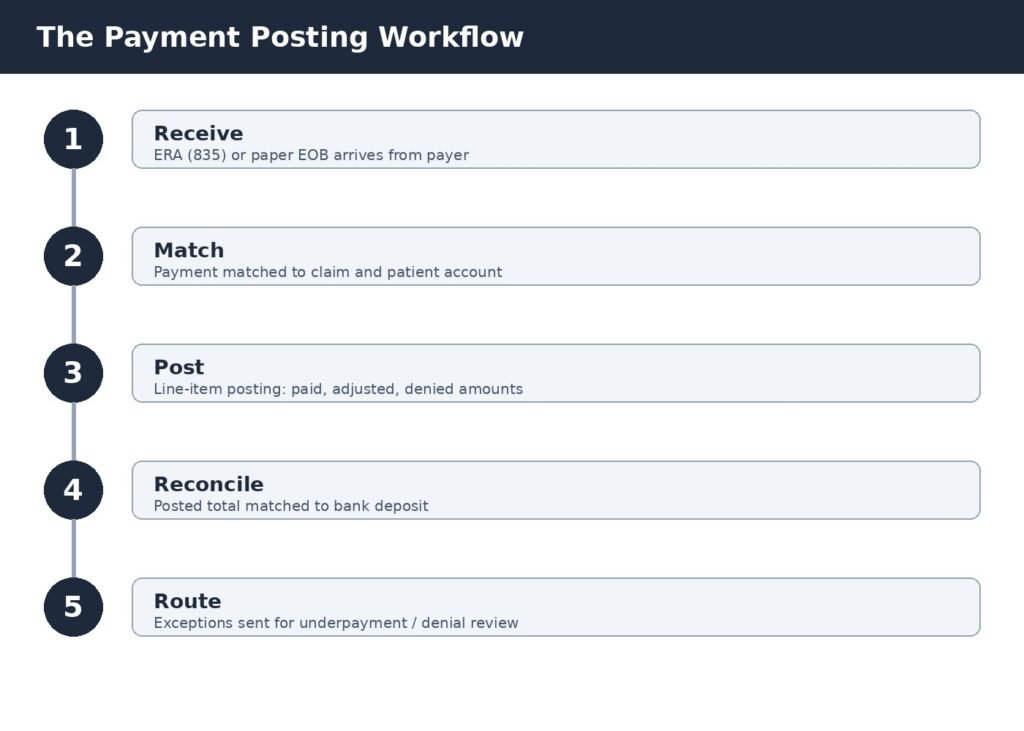
The five steps in the diagram above hold regardless of practice size: receive the remittance, match it to the correct claim and patient, post each line item with its specific adjustment code, reconcile the posted total against the bank deposit, and route anything unusual to a person instead of letting it post silently. The step practices skip most often is reconciliation — confirming that what got posted actually matches what hit the bank account, not just that a number was entered somewhere.
Skipping reconciliation is how unapplied cash accumulates: money the bank shows as received but that never got matched to a specific patient account. Left alone, unapplied cash distorts both the credit-balance report and the true state of A/R, since the revenue technically arrived but isn’t reflected against any open balance.
One risk that’s easy to overlook until it happens: key-person dependency. If only one staff member fully understands the posting and reconciliation workflow, their vacation, illness, or departure creates a backlog that can take weeks to clear. Cross-training at least two people on the reconciliation step — not just data entry — is the most direct protection against that risk, and it’s worth doing before volume grows to the point where a gap becomes expensive.
Manual vs. Automated Payment Posting
Manual posting means a staff member opens each EOB or ERA, locates the claim, and keys in the payment, adjustment, and any denial detail by hand. Automated posting uses a rules engine to match ERA data to open claims and post routine payments without a person touching them, escalating only the exceptions — underpayments, denials, or unmatched remittances — for manual review.
Manual vs. Automated Posting
| Factor | Manual Posting | Automated (Rules-Based) Posting |
| Speed per remittance | Several minutes per claim | Seconds per claim, batch processed |
| Error risk | Higher — keying and matching errors | Lower for routine payments; risk shifts to rule accuracy |
| Underpayment detection | Relies on manual audit | Can flag automatically via allowed-amount comparison |
| Staff time (directional) | Higher — hours per batch | Lower — exception handling only |
| Best fit | Low volume, complex payer mix | High volume, standardized ERA payers |
When evaluating posting automation, the auto-post rate itself isn’t the most useful comparison point — it’s how the system handles exceptions. A system that routes underpayments, denials, and credit balances into distinct, clearly labeled work queues — and lets rules be tuned for specific payer behavior rather than applying one generic threshold to everyone — will surface real problems faster than one that simply reports a high percentage posted.
Handling the Exceptions: Underpayments, Denials, and Takebacks
Routine payments are the easy part — it’s the exceptions that separate a strong posting process from a weak one. An underpayment occurs when a payer pays less than the contracted rate without an explicit denial code explaining why; a full or partial denial comes with a specific reason code attached; a takeback (or provider-level adjustment) claws back a prior payment, often for a reason unrelated to the current claim. Each requires a different next step, and posting all three the same way — as a closed, paid claim — is how revenue quietly disappears.
Worked Example: Payment-to-Allowed Percentage Check
Formula: Payment-to-Allowed % = Amount Paid ÷ Contracted Allowed Amount × 100. Example: a plan design sets patient coinsurance at 10%, so the expected payer payment is 90% of the allowed amount. A claim with a $500 allowed amount that pays $400 gives 400 ÷ 500 = 80% — 10 points below expectation, which flags it for review even though no denial code was attached.
Credit Balances and the 60-Day Overpayment Rule
A credit balance — money posted to an account that exceeds what’s actually owed — is one of the clearest signals that something in the posting process needs attention. It can come from a duplicate payment, an overpayment relative to the contracted rate, or a posting error, and letting credit balances sit unresolved isn’t just a bookkeeping problem.
For Medicare overpayments specifically, federal regulation 42 CFR § 401.305 requires providers to report and return an identified overpayment within 60 days of identification — treating an overpayment held past that deadline as a false-claims-adjacent obligation, not a minor administrative lapse. That’s a firm legal deadline, not a practice benchmark, and it starts running the moment the overpayment is identified, whether or not the exact dollar amount has been finalized yet.
A commonly cited practitioner benchmark, offered in HFMA’s own published Q&A rather than as a formal mandate, holds credit balances under one day of net revenue. Reconciling deposits daily and routing credit balances for review immediately — rather than letting them wait for a monthly cleanup — is the most direct way to stay inside that range.
Illustrative scenario (not an actual client record): a payment poster receives a $500 EFT and, without a matching remittance detail on hand, posts it to the first open claim under the patient’s name. The payment actually belonged to a different date of service. The correct claim now shows an unbilled $500 balance, and the wrong claim shows a $500 credit. Neither error is visible until someone reconciles the account or a refund request arrives from the payer — by which point untangling it takes far longer than posting it correctly the first time would have.
Measuring Payment Posting Performance
Three metrics anchor most posting-quality reviews: posting accuracy rate, ERA auto-post rate, and posting turnaround time. Accuracy measures how many audited postings required no correction; auto-post rate measures how much volume clears without manual touch; turnaround measures how long a remittance sits before it’s fully posted.
The three calculations below use numbers most billing teams already track. None takes more than a couple of minutes to run against your own posting log.
Worked Example: Posting Accuracy Rate
Formula: Posting Accuracy Rate = Postings Without Correction ÷ Total Postings Audited × 100. Example: a monthly audit sample of 200 postings finds 6 that needed correction, giving (200 − 6) ÷ 200 = 97% — just under the commonly reported 98–99% range, worth a root-cause check on those six errors.
Worked Example: ERA Auto-Post Rate
Formula: Auto-Post Rate = ERAs Posted Without Manual Intervention ÷ Total ERAs Received × 100. Example: 850 of 1,000 ERAs received in a month post automatically, giving 850 ÷ 1,000 = 85% — at the lower edge of the commonly reported 85–95% range, suggesting posting rules may need tuning for a specific payer.
Worked Example: Posting Turnaround Time
Formula: Turnaround Time = Date Fully Posted − Date Remittance Received (in hours or days). Example: an ERA receive Monday morning is fully post and reconcile by Tuesday afternoon — roughly 30 hours, inside the commonly cited 24–48 hour target.
If one of your own numbers falls outside its range, treat that as the specific step to investigate — not a signal to overhaul the entire posting process at once.
Why a Blended Accuracy Rate Can Hide a Real Problem?
A practice-wide posting accuracy rate can look healthy while one payer or one staff member’s queue quietly underperforms. The table below is a hypothetical construct built to illustrate that methodology point — not figures pull from any study or client record.
Illustrative Posting Accuracy by Payer Type (Hypothetical Example)
| Payer Type | Hypothetical Accuracy Rate | Note |
| Medicare (standardized ERA) | ~99% | Highly standardized remit format |
| Major commercial payers | ~97% | Generally standardized, some variation |
| Medicaid / state plans | ~93% | More manual handling, format variance |
| Smaller regional payers | ~89% | Often paper EOB, non-standard codes |
| Blended practice average | ~96% | Masks the regional-payer gap |
Illustrative scenario (not an actual client record): a multi-payer practice reports a 96% blended posting accuracy rate and assumes the process is healthy. A payer-level breakdown shows smaller regional payers sitting closer to 89%, well below the commonly reported 98–99% range, hidden by strong performance on Medicare and major commercial claims. The specific percentages above are construct to demonstrate this point, not source data. Actual figures vary by practice and payer mix; verify against your own posting audit log.
How to Use These Numbers Correctly?
A benchmark is only useful compare like-for-like. Comparing a practice that’s mostly Medicare and standardized ERAs to one with a heavy regional-payer, paper-EOB mix will produce a misleading conclusion in either direction. Match payer mix, remittance format, and reporting period before drawing conclusions from a single figure.
One missed benchmark in a single month is a signal to investigate, not a verdict on the whole process. Look for a pattern across two or three reporting periods, and check whether one payer or one staff member’s queue is driving the shift before assuming the entire workflow needs to change.
Timeframe to Improvement
These numbers shift depending on current posting volume, payer mix, and how much of the workflow is already automate — and time isn’t the only constraint. Vendor selection, rule configuration, and staff testing usually drive the real timeline more than the technology itself.
| Change Made | What It Actually Takes | Realistic Timeframe |
| Switch to rules-based ERA auto-posting | Vendor selection, payer-rule configuration, parallel testing before go-live | 4–8 weeks with a vendor; longer if building rules in-house |
| Add daily deposit reconciliation | Process change plus clearing any existing backlog | Immediate for new deposits; 1 billing cycle to clear backlog |
| Implement underpayment flagging rules | Loading contracted rates per payer, setting variance thresholds | 2–3 weeks to configure; 1–2 billing cycles to tune |
| Retrain staff on payer-specific posting rules | Documented procedures plus supervised posting review | 1 billing cycle to train; 2–3 to see consistent results |
Quick Summary
- Post remittances within 24–48 hours of receipt, and reconcile against the actual bank deposit the same day.
- Treat underpayments, denials, and takebacks as three distinct exceptions — don’t post all three as a closed, paid claim.
- Track posting accuracy (industry-cited target: 98–99%+) and ERA auto-post rate (85–95%).
- Keep credit balances under roughly one day of net revenue, and resolve them daily, not monthly.
- Report and return any identified Medicare overpayment within 60 days — that’s a legal deadline, not a target.
- Check posting accuracy by payer, not just the blended average — one payer can hide a real gap.
Self-Assessment Checklist
Answer yes or no to each question, then use the scoring guide below.
- Do you know your current posting accuracy rate, even roughly?
- Can you name your two or three lowest-accuracy payers?
- Do you post remittances within 24–48 hours of receipt?
- Do you reconcile posted totals against actual bank deposits daily?
- Is there a rule that flags any payment below roughly 95% of the allowed amount?
- Do denials get route to a work queue instead of being post as close claims?
- Are credit balances review and resolve daily rather than monthly?
- Do you have a documented process for the 60-day Medicare overpayment deadline?
- Are at least two staff members train on reconciliation, not just data entry?
- Do staff receive ongoing training on payer-specific remittance codes?
Scoring guide:
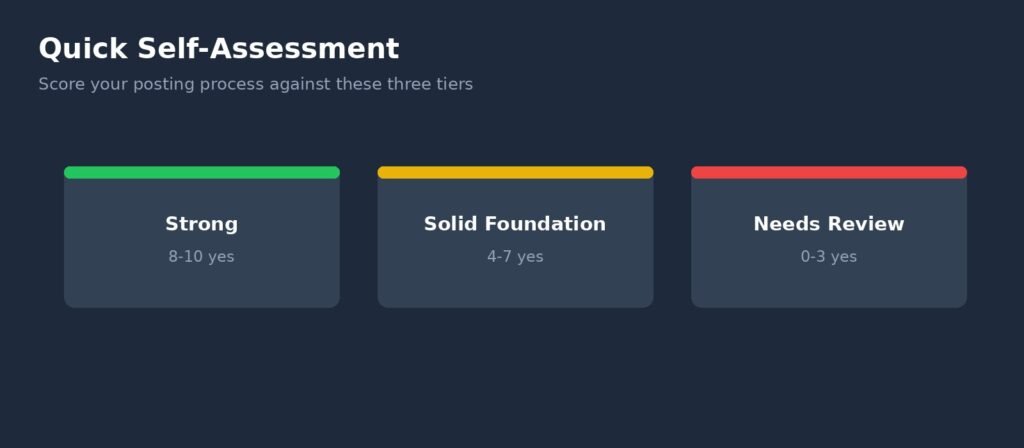
- 8–10 answers of yes: your posting process is solid — the priority now is holding the line as volume grows.
- 4–7 answers of yes: posting is functional but leaking accuracy somewhere — the “no” items are the likely source.
- 0–3 answers of yes: this is a sign your posting and reconciliation workflow needs a structural rebuild, not a patch.
Expert Opinion
Here’s where even careful practices go wrong: they implement automation, watch the auto-post rate climb toward the industry-cited range, and treat that number as the win. But a rising auto-post rate only tells you volume is moving faster — not whether the shrinking manual queue is still catching the underpayments and misapply denials that actually cost money, or just the easy exceptions that were never going to miss anyway.
Sourcing on these figures varies quite a bit: posting accuracy and auto-post ranges come from widely repeat industry figures, the credit-balance benchmark is one named practitioner’s publish opinion rather than a formal HFMA mandate, and the 60-day overpayment deadline is a binding federal regulation, not a target. None of these numbers is a guarantee for any individual practice — payer mix and remittance format both shift what’s realistic.
The direction of travel is worth noting, too. The shift underway is toward rules-based auto-posting as the default for standardized ERA payers, with manual review concentrated entirely on genuine exceptions rather than spread across every remittance. Practices that build toward that split — and keep auditing what the exception queue is actually catching, not just how small it’s gotten — are likely to find the benchmarks in this guide easier to hit over time.
— EON Med Solutions RCM Team
Frequently Asked Questions
Best practices for posting insurance payments accurately
What is payment posting in medical billing?
It’s the process of recording payer and patient payments — along with any adjustments, denials, or write-offs — into a practice’s billing system at the claim and service-line level, based on the remittance advice received.
What is a good payment posting accuracy rate?
Industry sources commonly report 98–99%+ as a widely used benchmark for audited postings that require no correction, though this varies by payer mix and remittance format.
What is a good ERA auto-post rate?
A commonly reported range is 85–95% of electronic remittances posting without manual intervention, with the rest routed as exceptions for underpayments, denials, or unmatched claims.
What’s the difference between an EOB and an ERA?
An EOB is the paper version of a remittance; an ERA (the ASC X12 835 transaction) is the HIPAA-standard electronic format for the same information, and it’s what most auto-posting systems are built to read.
How is an underpayment different from a denial?
A denial comes with a specific payer reason code explaining why a claim wasn’t pay. An underpayment is a payment below the contracted rate without a matching denial code — it often requires comparing the payment to the contracted allowed amount to catch.
How quickly must a Medicare overpayment be return?
Federal regulation (42 CFR 401.305) requires providers to report and return an identified Medicare overpayment within 60 days of identification, or face treatment as a false-claims-adjacent obligation.
What is a good turnaround time for posting payments?
A commonly cited practical target is within 24 to 48 hours of receiving the remittance, with same-day reconciliation against the actual bank deposit.
Does automated posting eliminate the need for manual review?
No. Automation handles routine, standardized remittances well, but underpayments, denials, and unmatched payments still need a person to review and resolve them.
What is unapplied cash, and why does it matter?
Unapplied cash is money the bank shows as received that hasn’t been match to a specific patient account. Left unresolved, it distorts both credit-balance reporting and the true state of accounts receivable.
When to Consider Professional Support?
Posting workflow and staff training can only fix so much on their own. A handful of signals usually mean the underlying process needs outside help: posting accuracy sitting below 97% for two consecutive audits, an ERA auto-post rate stuck below 80%, credit balances that routinely take longer than a week to resolve, or underpayments that only get caught by accident rather than by a systematic check.
When those signals show up together, it’s usually a sign that posting rules and reconciliation discipline haven’t kept pace with claim volume — not that any single staff member is falling short. At that point, practices generally look for support that treats posting as connected to the rest of the revenue cycle — accurate posting feeds accurate denial tracking, accurate A/R aging, and accurate patient statements — rather than as an isolated data-entry task. That’s the structure worth looking for, whichever vendor or in-house hire ends up filling the gap.
It’s an approach EON Med Solutions builds around directly. Payment posting, denial management, and reporting sit inside one connected revenue cycle process. So an underpayment caught during posting routes straight into payer-specific appeals instead of getting lost. Every plan includes a dedicated RCM manager, and there are no long-term contracts. You can evaluate the fit without committing years upfront. Results vary by practice and payer mix, so the useful next step is comparing your own numbers against the benchmarks above, not taking anyone’s word for it.
If your self-assessment score above flagged more than one gap, reach out to EON Med Solutions for a walkthrough of your current posting workflow. Reconciliation cadence, and underpayment detection. The goal is a clear, specific list of where accuracy is realistic to improve for your practice, not a generic pitch.
Sources & Methodology
- Published standards/regulations: the ASC X12 835 Electronic Remittance Advice as the HIPAA-mandated transaction standard (CMS.gov); the 60-day Medicare overpayment report-and-return deadline (42 CFR 401.305, eCFR.gov).
- Named benchmarking framework: HFMA’s MAP Keys initiative for revenue cycle metric definitions, including net days in credit balance; the specific under-one-day figure is a practitioner’s published opinion in HFMA’s own Q&A, not a codified mandate.
- Commonly reported industry ranges: posting accuracy rate, ERA auto-post rate, turnaround time, and manual-vs-automated error rates. Compiled from multiple RCM vendor and industry sources rather than one named study.
- Illustrative targets: the payer-type accuracy table, explicitly labeled as a hypothetical planning example rather than sourced data.
Actual results vary by practice, payer mix, and reporting period. Figures in this article reflect information available at the time of research. This should be verified against your own practice management or reporting system where precision matters.
Reference: CMS — Remittance Advice (ERA/835) resources and FAQs.
Ref: eCFR — 42 CFR § 401.305, Requirements for reporting and returning of overpayments.
Reference: HFMA — MAP Keys, industry-standard revenue cycle KPIs.
Related Reading on EON Med Solutions
Revenue Cycle Management services — how payment posting fits into the broader revenue cycle.
A/R Management — keeping accounts receivable accurate once payments are post.
Denial Management — what happens when posting surfaces a denial or underpayment.
Medical Billing KPIs to Track for Practices — a deeper look at the benchmarks referenced above.


