

Handling Secondary Insurance Claims Correctly
Handling secondary insurance claims correctly means submitting to the primary payer first, waiting for its Explanation of Benefits (EOB), then submitting the secondary claim with that EOB attached so the second payer can apply coordination of benefits (COB) rules to the remaining balance. The order matters: a secondary claim submitted before the primary has adjudicated, or without the primary’s EOB attached, is one of the most common and avoidable causes of a coordination-of-benefits denial.
Handling secondary insurance claims correctly. Tens of millions of patients carry more than one health plan at the same time, and every one of those claims has to be billed in the right order to get paid. Coordination-of-benefits (COB) errors. The wrong payer billed first, a missing primary EOB, an outdated COB record. These are a leading cause of claim denials, and they take far longer to resolve than an ordinary denial. This guide covers how payer order is actually determined, the step-by-step process for submitting a secondary claim, and the benchmarks that separate a clean COB process from one that’s quietly losing time and revenue. Near the end, you’ll find a short self-assessment checklist to score your own process against these numbers.
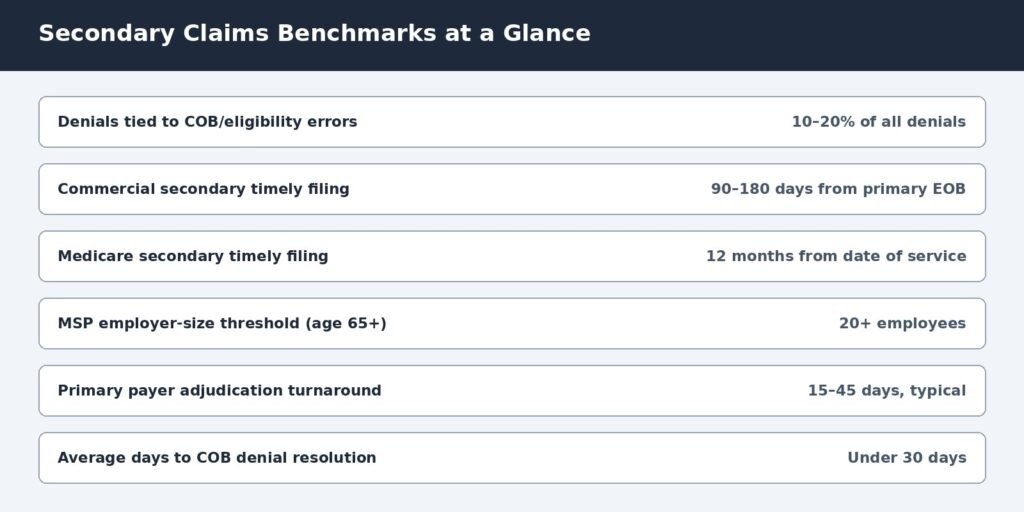
Key Numbers Cheat Sheet
Each figure below is unpacked further in this guide — bookmark this table as a quick reference rather than trying to absorb it all now.
| Metric | Practical Target/Range | Review Frequency | Primary Source |
| Denials tied to COB/eligibility errors | 10–20% of all denials | Monthly | Commonly reported industry range¹ |
| Commercial secondary timely filing window | 90–180 days from primary EOB date | Per claim | Payer-contract terms¹ |
| Medicare secondary timely filing window | 12 months from date of service | Per claim | Published federal standard² |
| MSP employer-size threshold (age 65+) | 20+ employees keeps group plan primary | At enrollment/verification | Published federal standard² |
| Primary payer adjudication turnaround | 15–45 days, typical | Per claim | Commonly reported industry range¹ |
| Average days to COB denial resolution | Under 30 days | Per denial | Commonly reported industry range¹ |
¹ Commonly reported industry range = a figure cited consistently across multiple industry sources rather than one controlled study. ² Published federal standard = a codified rule (CMS regulation or manual), not a target a practice sets for itself.
What Coordination of Benefits Actually Determines?
Coordination of benefits (COB) is the set of rules insurers use to decide which plan pays first when a patient has more than one policy, and how much each plan pays so the combined payment never exceeds the total allowed amount. Those rules aren’t invented by each payer independently — most commercial COB order follows the NAIC Coordination of Benefits Model Regulation, which most states have adopted in substantially similar form, while Medicare and Medicaid follow their own federal rules layered on top.
The full model language is published by the NAIC Coordination of Benefits Model Regulation, and it’s worth knowing the three most common order-determining rules even if your billing software applies them automatically: the non-dependent/dependent rule (the plan covering someone as an employee or subscriber pays before the plan covering them as a dependent), the active/inactive rule (active-employee coverage pays before retiree coverage), and the birthday rule for dependent children.
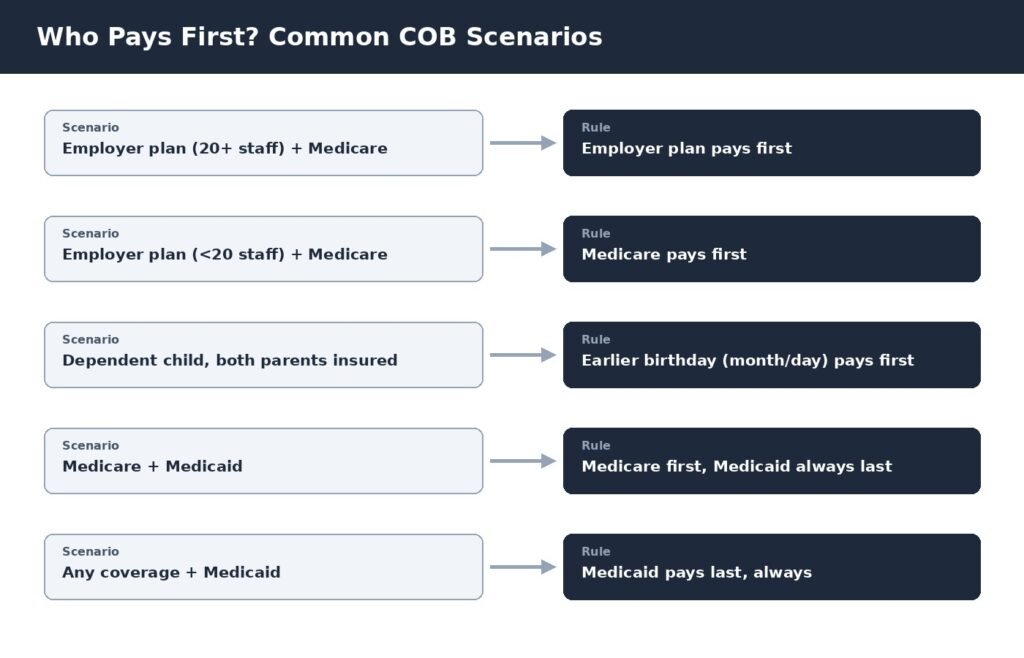
Who Pays First? Common COB Scenarios
| Scenario | General Rule |
| Dependent child covered by both parents’ plans | Parent whose birthday (month/day) falls earlier in the year is primary |
| Patient is 65+, employer has 20+ employees | Employer group health plan pays first; Medicare is secondary |
| Patient is 65+, employer has fewer than 20 employees | Medicare pays first |
| Patient has Medicare and Medicaid | Medicare pays first; Medicaid pays last, always |
| Patient has Medicaid and any other coverage | Medicaid is the payer of last resort in every case |
Medicare, Medicaid, and the Rules That Aren’t Optional
Commercial COB order is a widely followed model, but Medicare and Medicaid operate under binding federal rules, not just industry convention. Under the Medicare Secondary Payer (MSP) program, Medicare is secondary to an employer group health plan whenever the plan covers a beneficiary aged 65 or older through their own or a spouse’s current employment at an employer with 20 or more employees. Below that threshold, Medicare typically pays first.
CMS maintains detailed guidance on these determinations through its Coordination of Benefits & Recovery program, and getting the employer-size determination. Wrong is one of the more common — and more consequential — COB mistakes. Since it can trigger a Medicare recovery action well after the claim was originally paid.
Medicaid follows a different but equally firm rule: it is the payer of last resort in essentially every circumstance. Federal regulation requires that all other available coverage. Commercial insurance, Medicare, even liability or auto insurance when applicable — be billed and adjudicated before Medicaid considers the claim.
This requirement, known as third-party liability (TPL). It is documented in detail in Medicaid’s own COB/TPL handbook, and billing Medicaid before another known payer has been billed. It is one of the most reliable ways to generate an automatic denial.
The Step-by-Step Secondary Claim Process
The mechanics are consistent across payers, even when the specific rules for who’s primary change. First, confirm coordination of benefits is current — patient-reported coverage changes constantly, and an outdated COB record. It is one of the most preventable sources of denial. Second, submit the claim to the primary payer only, and wait for it to fully adjudicate. Third, once the primary’s EOB or ERA arrives, prepare the secondary claim using that EOB’s paid amount. Adjustments, and any patient responsibility as the basis for what the secondary payer needs to see.
Fourth, attach the primary EOB to the secondary submission — most secondary payers require it as documentation. Whether the claim goes electronically or on paper. Fifth, submit through the correct format for that payer, since some secondary payers still require paper submission with physical attachments. Even when the primary claim went electronically. Finally, track the secondary claim status the same way a primary claim would be tracked. A secondary claim can still be denied, and it has its own timely filing clock that starts from the primary’s adjudication date. Not the original date of service.
Handling secondary insurance claims correctly-secondary claim
The most common trap here is assuming the secondary claim will travel electronically just because the primary did. Many secondary payers — particularly regional plans and some state Medicaid programs. Still require paper submission with the primary EOB physically attached. Which means an entirely separate workflow with its own tracking and its own timely filing clock. Knowing in advance which payers on your panel require paper. It is the difference between a claim that processes cleanly and one. That sits in a mailroom for two weeks before anyone realizes it was never actually submitted.
Getting this sequence wrong compounds with denial management workload downstream. A COB denial that arrives near a timely filing deadline leaves. Very little runway to correct and resubmit before the claim becomes unrecoverable.
It’s worth being clear about what happens once both payers have adjudicated. The secondary payment reduces the patient’s remaining balance, but it doesn’t necessarily eliminate it. If the secondary plan carries its own deductible, coinsurance, or coverage limitation. The patient can still owe something after both payers have paid their share. That remaining figure is what ends up on the patient statement — which is exactly why clear. Itemized statement design matters just as much for a dual-coverage patient as for one with a single plan.
Common COB Denial Codes and What They Mean?
Two adjustment reason codes account for most coordination-of-benefits denials, and recognizing them immediately saves a round of investigation. CARC 22 (“this care may be covered by another payer per coordination of benefits”) means the payer believes another plan should be billed first — the fix is usually to verify COB and resubmit to the correct primary. CARC 23 (“the impact of prior payer(s) adjudication”) appears on a secondary claim and simply reflects how the primary payment affected what’s left owed — it’s informational, not necessarily a rejection, but it needs to be read carefully against what was actually submitted.
Worked Example: Timely Filing Runway on a COB Denial
A commercial secondary payer allows 120 days from the primary EOB date to file. The primary adjudicates on day 0, and the secondary claim is submitted on day 5 but comes back with a CARC 22 denial on day 50 — because COB on file was outdated. That leaves 120 − 50 = 70 days to correct the COB record and resubmit, which is workable, but only if the denial is worked immediately rather than sitting in a queue for a few weeks first.
Preventing COB Errors Before They Happen
Most COB denials trace back to one of a small number of preventable gaps: coverage verified once at intake and never rechecked, a patient’s relationship to the subscriber (self, spouse, child) entered incorrectly, or a claim sent to the payer the patient reported rather than the payer that’s actually primary under COB rules. Re-verifying COB at each visit — not just at initial registration — catches most of these before a claim is ever submitted.
Illustrative scenario (not an actual client record): a patient’s spouse changes jobs and gains new employer coverage, but the patient’s registration record still lists the old plan as primary. Claims continue going to the outdated payer for months, generating a wave of CARC 22 denials once that payer finally recognizes the coverage lapsed. None of the individual claims were wrong on their own — the COB record simply hadn’t been refreshed since the initial visit, which is exactly the kind of gap an annual (or visit-by-visit) COB recheck is designed to catch.
Measuring Secondary Claims Performance
Two metrics are worth tracking specifically for secondary and COB-related claims, separate from general denial reporting: the COB denial rate (COB-coded denials divided by total claims) and the average days to COB resolution (from denial date to corrected resubmission). Both tend to get buried inside general denial-rate reporting, which hides how much of total denial volume is actually a payer-order problem rather than a coding or eligibility problem.
Worked Example: COB Denial Rate
Formula: COB Denial Rate = COB-Coded Denials ÷ Total Claims Submitted × 100. Example: 45 CARC 22/23 denials out of 3,000 claims submitted in a month gives 45 ÷ 3,000 = 1.5% of total claims — but if COB/eligibility denials make up 15% of the practice’s overall denial volume, that 1.5% is disproportionately expensive to work relative to its size.
Worked Example: Average Days to COB Resolution
Formula: Average Days to COB Resolution = Sum of (Resolution Date − Denial Date) ÷ Number of COB Denials Resolved. Example: 10 COB denials resolved in a month with resolution times of 12, 15, 18, 22, 25, 28, 30, 35, 40, and 45 days sum to 270 days; 270 ÷ 10 = 27 days average — just inside the commonly cited under-30-day target. The average alone hides the problem, though: the 45-day outlier is the one worth investigating, since it’s the case most likely to be sitting close to a timely filing deadline.
If your own COB denial share falls outside the commonly reported 10–20% range, that’s the specific queue to audit first — not necessarily a sign the whole denial process needs an overhaul.
How to Use These Numbers Correctly?
A benchmark here is only useful compared like-for-like. A practice with a young, mostly single-coverage patient population will naturally see fewer COB claims than one serving an older population with significant Medicare/commercial overlap, and comparing the two COB denial rates directly will produce a misleading conclusion. Match patient population and payer mix before drawing conclusions from a single figure.
One elevated month is a signal to investigate, not a verdict on the whole process. Look for a pattern across two or three reporting periods, and check whether one specific payer or one registration process gap is driving the shift before assuming the entire COB workflow needs to change.
Timeframe to Improvement
Take these as planning benchmarks rather than guarantees — patient population, payer mix, and how thoroughly COB verification is already built into registration all move the real number.
| Change Made | What It Actually Takes | Realistic Timeframe |
| Add COB re-verification at every visit | Front-desk workflow change plus staff training | Immediate rollout; 1–2 billing cycles to see denial impact |
| Build a payer-order desk reference (birthday rule, MSP thresholds, Medicaid TPL) | One-time documentation effort | 1–2 weeks to build; ongoing to maintain |
| Separate COB denial tracking from general denial reporting | Reporting/dashboard configuration | 2–4 weeks |
| Audit aged COB denials against timely filing deadlines | One-time cleanup plus monthly recurring review | Immediate for backlog; ongoing monthly after |
Quick Summary
- Always bill the primary payer first and wait for its EOB before submitting to the secondary.
- Attach the primary EOB to every secondary claim — most secondary payers require it as documentation.
- Know the three order-determining rules: non-dependent/dependent, active/inactive, and the birthday rule.
- Medicare and Medicaid order is federally mandated, not a convention — Medicaid always pays last.
- Re-verify COB at every visit, not just at initial registration, to catch coverage changes early.
- Track COB denial rate and average resolution time separately from general denial reporting.
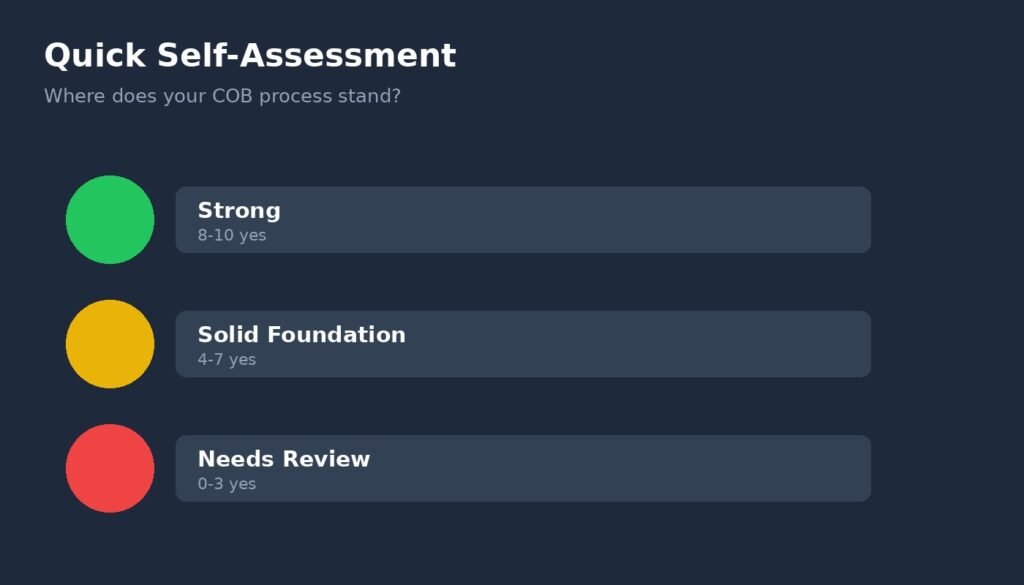
Self-Assessment Checklist
Answer yes or no to each question, then use the scoring guide below.
- Do you know what percentage of your denials are COB-related, even roughly?
- Can your front-desk staff explain the birthday rule without looking it up?
- Do you re-verify coordination of benefits at every visit, not just at initial registration?
- Do you have a process for re-verifying COB when a patient reports a coverage change mid-treatment?
- Do staff have a quick-reference guide for the birthday rule, MSP thresholds, and Medicaid TPL?
- Do you always attach the primary EOB when submitting a secondary claim?
- Do you wait for full primary adjudication before submitting to the secondary?
- Are CARC 22 and CARC 23 denials routed to a dedicated work queue?
- Do you follow up on COB denials within about 45 days of receipt?
- Do you review COB denial trends by payer, not just as a blended total?
Scoring guide:
- 8–10 yes answers puts your COB process in good standing — keep verifying coverage order at every visit, not just at intake.
- 4–7 yes answers means COB is handled reasonably well but inconsistently — the “no” items are usually where denials creep back in.
- 0–3 yes answers means coordination of benefits isn’t being verified consistently, which is one of the more fixable causes of avoidable denials.
Expert Opinion
There’s a gap that shows up more than any other here: a practice invests in eligibility verification technology, watches the tool confirm coverage at intake, and still keeps generating CARC 22 denials months later. The tool isn’t the problem — the workflow around it is. A real-time eligibility check only prevents a COB denial if it runs before every claim, not just once at the first visit. Buying the capability and building the habit are two different projects, and most of the value sits in the second one.
That same split runs through the sourcing: Medicare and Medicaid payer order is set by federal law, not a target to hit; the NAIC model rules are a widely adopted framework most states follow; and the denial-rate and timing figures come from commonly reported industry ranges rather than a single controlled study.
None of these numbers is a guarantee for any individual practice — patient population and payer mix both shift what’s realistic. But a practice that re-verifies COB at every visit, tracks CARC 22/23 denials as their own category, and keeps a payer-order reference on hand is working from a stronger position than one that discovers a coverage change only after a claim bounces.
The direction of travel makes that habit more valuable, not less. As more payers move toward real-time eligibility and COB checks at the point of registration, practices that only catch these errors after a denial arrives will fall further behind those that catch them at check-in. Building COB verification into registration now, as a routine step rather than a billing-department cleanup task, is the shift that pays off as that trend continues.
— EON Med Solutions RCM Team
Frequently Asked Questions
Handling secondary insurance claims correctly
What does it mean to handle secondary insurance claims correctly?
It means submitting to the primary payer first, waiting for its EOB, then submitting the secondary claim with that EOB attached so the secondary payer can apply coordination of benefits and pay only what’s actually still owed.
What is a good COB denial rate?
Industry sources commonly report that 10–20% of all claim denials trace back to coordination-of-benefits or eligibility errors — tracking this share separately from general denials helps show whether it’s a meaningful share of your own denial volume.
What is the birthday rule?
A National Association of Insurance Commissioners (NAIC) model rule that determines which parent’s plan is primary for a dependent child: the parent whose birthday (month and day, not year) falls earlier in the calendar year has the primary plan.
Does Medicaid ever pay first?
Essentially never. Medicaid is the payer of last resort under federal regulation — all other available coverage must be billed and adjudicated first, with very limited exceptions.
When is Medicare secondary to an employer health plan?
When a beneficiary aged 65 or older is covered by a group health plan through their own or a spouse’s current employment at an employer with 20 or more employees, the employer plan pays first and Medicare is secondary.
What’s a good timely filing window for secondary claims?
Commercial payers commonly allow 90 to 180 days from the primary payer’s EOB date, not the original date of service — Medicare generally allows 12 months from the date of service.
What does a CARC 22 denial mean?
It signals the payer believes another plan should have been billed first. The usual fix is to verify current coordination of benefits and resubmit to the correct primary payer.
How often should coordination of benefits be verified?
At every visit is the safest practice, since coverage changes — a new job, a new spouse’s plan, a Medicaid eligibility shift — happen far more often than most registration workflows account for.
Can a secondary claim be denied even if the primary paid correctly?
Yes. A secondary claim can be denied for missing the primary EOB, being submitted in the wrong format, or being sent before the primary fully adjudicated, regardless of whether the primary’s payment itself was correct.
When to Consider Professional Support?
Staff training and a good desk reference can only fix so much on their own. A handful of signals usually mean the underlying process needs outside help: a COB denial rate that’s crept above 20% of total denials, secondary claims regularly missing timely filing windows, front-desk staff who can’t confidently answer basic payer-order questions, or a pattern of the same payer-order mistakes recurring month after month despite training.
When those signals show up together, it usually means COB verification hasn’t been built into the registration workflow itself — it’s being caught, if at all, downstream in billing, which is the most expensive place to catch it. At that point, practices generally look for support that treats COB as a front-end verification problem connected to the rest of the revenue cycle, not an isolated billing correction task. That’s the structure worth looking for, whichever vendor or in-house process change ends up filling the gap.
It’s an approach EON Med Solutions builds around directly: coordination-of-benefits verification, denial management, and reporting sit inside one connected revenue cycle process, so a CARC 22 denial routes straight into a payer-order correction and resubmission instead of sitting in a generic denial queue. Every plan includes a dedicated RCM manager, and there are no long-term contracts — you can evaluate the fit without committing years upfront. Results vary by practice and patient population, so the useful next step is comparing your own numbers against the benchmarks above, not taking anyone’s word for it.
If your self-assessment score above flagged more than one gap, reach out to EON Med Solutions for a walkthrough of your current COB verification process, secondary claim tracking, and denial patterns — the goal is a clear, specific list of where accuracy is realistic to improve for your practice, not a generic pitch.
Sources & Methodology
- Published standards/regulations: Medicare Secondary Payer (MSP) rules and employer-size thresholds (CMS.gov); Medicaid’s payer-of-last-resort / third-party liability requirement (Medicaid.gov COB/TPL Handbook, grounded in 42 CFR Part 433 Subpart D).
- Named model framework: the NAIC Coordination of Benefits Model Regulation, which defines the non-dependent/dependent rule, active/inactive rule, and birthday rule most states have adopted in substantially similar form.
- Commonly reported industry ranges: COB-related denial share, commercial secondary timely filing windows, and primary payer adjudication turnaround, compiled from multiple industry sources rather than one named study.
- Illustrative scenario: the COB-lapse example, explicitly labeled as a hypothetical planning illustration rather than an actual client record.
Actual results vary by practice, patient population, and payer mix. Figures in this article reflect information available at the time of research and should be verified against your own denial and A/R reporting where precision matters.
Reference: CMS — Coordination of Benefits & Recovery Overview (Medicare Secondary Payer).
Ref: Medicaid.gov — Coordination of Benefits and Third Party Liability (COB/TPL) Handbook.
Reference: NAIC — Coordination of Benefits Model Regulation.
Related Reading on EON Med Solutions
Revenue Cycle Management services — how secondary claims and COB fit into the broader revenue cycle.
Denial Management — what happens when a COB error turns into a denial.
A/R Management — keeping secondary claims from aging past timely filing.
Medical Billing KPIs to Track for Practices — a deeper look at denial and A/R benchmarks.


